AI Overview
An uninsulated steel shed in Queensland gets hot by day and can drip condensation at night, so insulate the roof first. The cheapest time is when the roof sheets go on. That's when an anti-condensation blanket, a foil-faced insulation blanket, goes in under the sheets.
Key Highlights
- The roof takes the most sun, so most of the heat comes in through it.
- Condensation forms when warm, moist air inside hits roof sheets that cooled overnight.
- An anti-condensation blanket under the roof sheets handles the heat and the drips together.
- An R-value tells you how well insulation slows heat, and higher is better.
- A shed you live in has to meet the energy efficiency rules, and a plain shed doesn't.
- Insulating as the roof goes on costs far less than adding it later.
We insulate sheds in Queensland mostly to keep the heat out, and on the Gold Coast, good shed insulation also stops the roof dripping on whatever you store underneath. With nothing under the roof sheets, a steel shed can get far hotter inside than the air outside on a summer afternoon.
As shed builders, we size the insulation to what the shed is for. A carport rarely needs any and a workshop needs the roof done. A shed home has to meet the same energy rules as a house.
Why a Steel Shed Gets So Hot
Steel sheeting is thin and lets heat through easily. On a sunny day the roof sheets heat up and send that heat straight into the shed. The west-facing walls do the same in the afternoon.
Insulation does the most good in the roof, because the roof takes the most sun for the longest. Roof colour helps too, since a lighter colour reflects more of the sun's heat than a dark one.
Why a Shed Roof Drips Condensation
The drip you find on a dry morning is usually condensation. On a clear night the roof sheets cool down fast. When warm, moist air inside the shed touches the cold steel, the moisture turns to water and drips.
It's worst in humid coastal weather, and in sheds holding cars, animals or anything else that adds moisture to the air. It rusts tools, marks cars and wets whatever is on the shelves.
The fix is a layer between the roof sheets and the air inside, so the moist air never reaches the cold steel. That's why the blanket that insulates the roof also stops the drip.
Choosing the Best Shed Insulation
Each type of shed insulation does a different job, and plenty of insulated sheds use two of them together.
Anti-condensation blanket
This is a glasswool blanket with a foil face. It's laid over the purlins, the steel rails the roof sheets fix to, before the sheets go on. It usually sits on safety mesh, a wire mesh laid under the roof so nobody can fall through, and it insulates and stops condensation in one layer.
Reflective foil
Reflective foil, called sarking, bounces radiant heat away. Laid over the purlins, it catches condensation and runs it to the gutter, but on its own it adds little insulation.
Bulk batts in lined walls
Glasswool or polyester batts fit between the wall girts, the horizontal steel rails in the walls. A lining such as plasterboard or panel then goes over the top.
Insulated panels
These are two steel sheets with a foam core bonded between them. The panel is the wall or roof and the insulation in one piece, which suits cool rooms and shed homes.
Anti-Condensation Blanket
An anti-condensation blanket is usually the answer for shed insulation in Queensland: a glasswool blanket with a foil face, laid over the purlins before the roof sheets go on. It insulates the roof and stops the condensation drip in one layer, and it's cheapest to fit while the roof is being built.
What R-Values Mean for a Shed
An R-value tells you how well a material slows down heat passing through it. The higher the number, the better it insulates.
What counts is the R-value of the whole roof or wall, including everything in it. Gaps, squashed batts and steel running through the insulation all bring it down, so how it's fitted matters as much as what you buy.
The Gold Coast and the Tweed coast are in climate zone 2 under the National Construction Code, which is warm and humid. Here, keeping heat out in summer matters more than keeping it in over winter. For hinterland blocks, we confirm the zone from the address.
Insulating a Shed Versus a Shed You Live In
Say your shed is approved as a Class 10a building, like a garage or a home workshop. The National Construction Code sets no energy efficiency rules for it, so how much you insulate is up to you.
A shed home approved as a Class 1a dwelling, which is a house, has to meet the energy efficiency rules for houses. Those rules set the roof and wall insulation and affect the windows too, so we design them in from the first drawing.
Is Shed Insulation Worth It?
For a shed used for storage or as a workshop, yes: it keeps the shed cooler in summer and stops the roof dripping condensation on whatever's underneath. For a shed approved as a home, shed insulation isn't optional, since it has to meet the same energy efficiency rules as a house. Either way, it's far cheaper to insulate as the roof goes up than to add it once the shed is built.
Insulating a Shed After It's Built
You can insulate a shed that's already built, but the roof is the hard part. An anti-condensation blanket sits between the purlins and the roof sheets, so it normally goes in as the roof is built. Adding one later means taking the sheets off, or fitting insulation underneath with a lining to hold it up.
Walls are easier. Batts go between the girts and a lining goes over them, which also turns a bare steel box into a room you can fit out.
Ventilation helps either way. Roof vents, or a ridge vent along the top, let the hot air out. That keeps the shed cooler on the hottest days and helps with condensation.
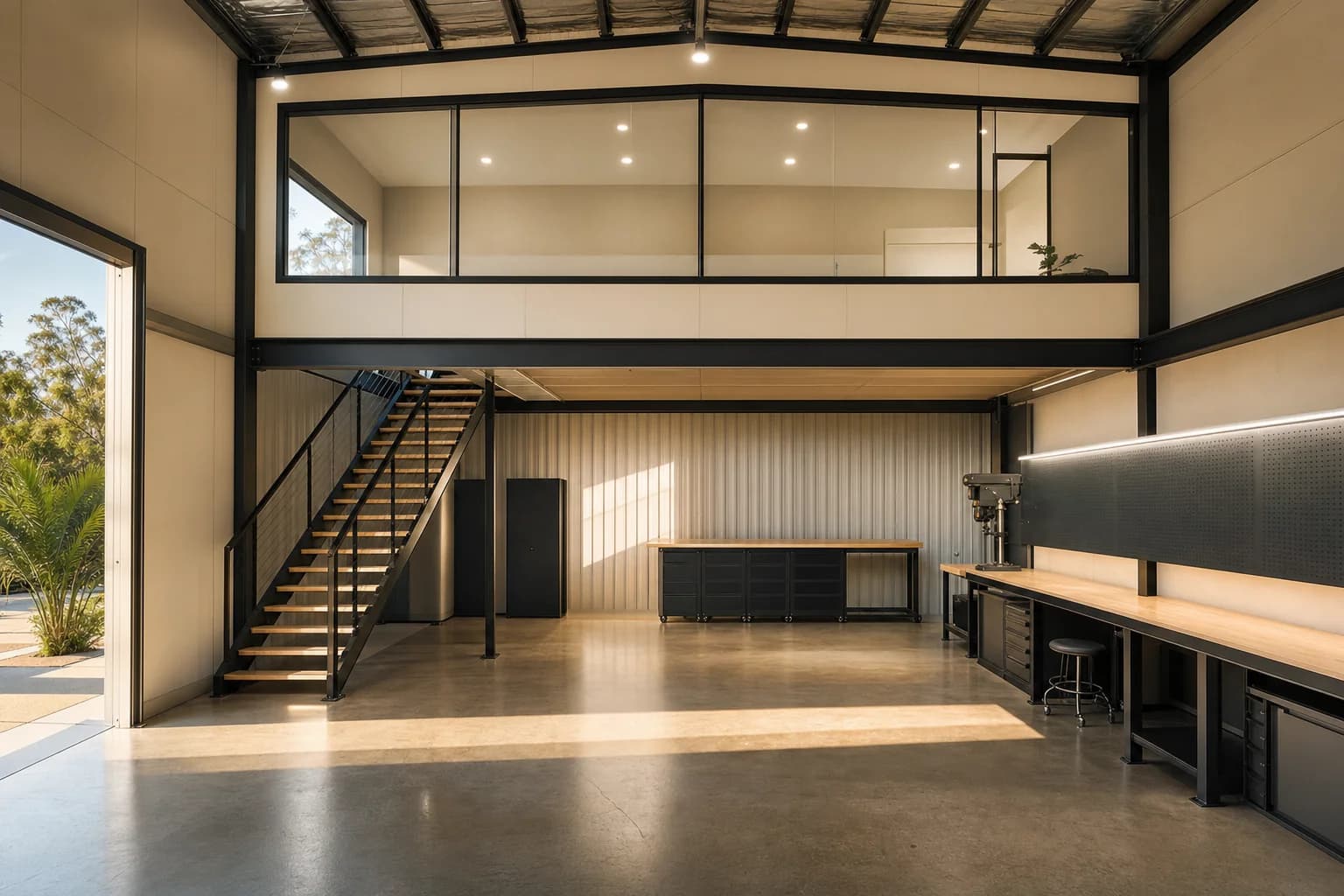
Read how we design and build fit-outs, mezzanines and workshops.
Fit-Outs, Mezzanines and Workshops